Google Display Ads Are Changing - And, Yes, Google Has Another AI-Powered Replacement
For years, traditional Google Display ad campaigns were pretty simple. They relied on direct, manual, and asset-based controls to serve visual ads across the Google Display network.
Our PPC agency primarily used this campaign type for “remarketing”. Remarketing is where someone visits your website, you add them to a remarketing audience, and you follow them around the internet with banner ads until they either convert or become extremely familiar with your logo.
It worked.
But Google Ads is changing, yet again.
Traditional standalone Display campaigns are increasingly becoming a thing of the past as Google shifts Display advertising into its newer, more automated ecosystem. And in 2026, that ecosystem naturally means more AI, more automation, and less control over what is actually happening with your advertising budget.
Two campaign types are at the center of this shift: Performance Max (PMax) and Demand Gen. But how do they actually compare against traditional Display Remarketing?
When we looked at our own campaign data, it became pretty obvious why Google is moving in this direction.
PMax vs Display vs Demand Gen: What Our Data Showed
We analyzed Google Ads performance from March 1, 2026 through August 26, 2026, comparing three PPC campaign types:
Performance Max
Traditional Display Remarketing
Demand Gen
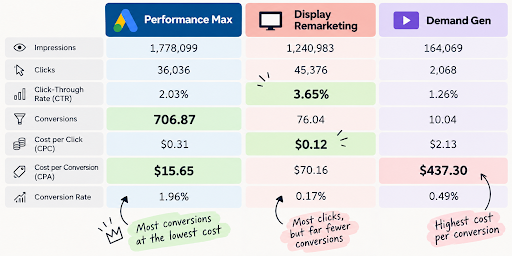
At first glance, Display Remarketing looked great. It generated more than 45,000 clicks at an average CPC (cost per click) of roughly $0.12, with a 3.65% CTR. Cheap traffic! Everyone celebrate!
Except clicks don't pay the bills.
When we looked at conversions, the story changed dramatically.
Performance Max Results
706.87 conversions
$15.65 cost per conversion
1.96% conversion rate
Display Remarketing Results
Approximately 76 conversions
$70.16 cost per conversion
Demand Gen Results
10.04 conversions
$437.30 cost per conversion
PMAX generated roughly 9x more conversions than Display Remarketing at less than one-quarter of the cost per conversion. So while Display was very good at getting people to click, PMAX was considerably better at getting them to actually convert.
And that distinction matters.
Google Is Moving Away From the Old Display Ads Model
Traditional Display gave advertisers a lot of control. You could choose audiences, placements, topics, demographics, bidding strategies, creative, and detailed remarketing segments. Google's newer philosophy is basically:
Give us your goal, your creative assets, your conversion data, and some audience signals. We'll take it from here.
Comforting? Maybe to some...but also slightly terrifying for control-freak marketers….
But that's the fundamental idea behind PMax and, increasingly, Demand Gen. Instead of advertisers deciding exactly where every paid search ad should appear, Google's machine learning systems are trying to make more of those decisions based on the outcome you're trying to generate.
PMax Is Becoming the Performance Engine
Performance Max can serve ads on the Display network. But will it? Google decides where PMax ads are served… for now that is (there are rumblings around the industry that we may have more control over this soon).
As of right now, PMax can serve ads across Google's broader ecosystem, including Search, YouTube, Discover, Gmail, Maps, and the Google Display Network. PMax asks: Where can Google's AI find someone most likely to convert?
Our data gives a pretty convincing argument Google found users to convert. PMax generated 706.87 conversions at a $15.65 CPA, making it easily the strongest campaign in our analysis from a direct-response perspective.
For advertisers focused on leads, sales, and revenue, PMax is increasingly becoming the workhorse. But that doesn't mean you should throw every campaign objective into PMax, and hand your ad budget to the Google robots. There's still a role for more deliberate visual and audience-focused advertising.
That's where Demand Gen comes in.
Display Ads Are Moving to Demand Gen
Google is moving traditional Display functionality into Demand Gen, giving advertisers access to visual inventory across areas like YouTube, YouTube Shorts, Discover, Gmail and the Google Display Network.
The important thing is that Demand Gen isn't simply “Display 2.0.,” Display is sunsetting.. It’s going bye-bye.
Traditional Display was largely about banner advertising and remarketing across websites. Demand Gen is designed more broadly around visual discovery, audience engagement and creating demand before someone is actively searching for your product or service.
In other words:
PMAX = capture and convert demand.
Demand Gen = create and nurture demand.
That's an oversimplification, but it's a much more useful way to think about the two.
So Why Did Demand Gen Perform So Poorly?
Our Demand Gen campaign generated just 10.04 conversions at a $437.30 CPA. Yikeeeesssss.
But that doesn't mean Demand Gen doesn't work. Demand Gen often operates earlier in the customer journey. Someone scrolling YouTube Shorts isn't necessarily a viable target for immediate lead generation or ticket sales compared to someone actively searching for a product. So judging Demand Gen exclusively against PMax's immediate CPA isn’t a fair comparison.
The better question is:
What do we want this campaign to do? What’s the end game?
If the goal is immediate conversions, our data clearly favors PMax.
If the goal is brand awareness, testing creative, generating awareness or visually re-engaging potential customers, Demand Gen may still have an important role.
How Can We Utilize Remarketing Lists Now?
Everyone loves this answer….. IT DEPENDS!
If you want to use a Remarketing list in a PMax campaign, those lists act as “signals” now, so we are basically just giving Google some guardrails.
If you want a strict Remarketing campaign, Demand Gen is the better option. You can force your Demand Gen campaign to serve exclusively as a strict remarketing engine.
As of right now, advertisers will still be able to use first-party audiences like:
Website visitors
Product viewers
Cart abandoners
Form abandoners
Previous customers
Email subscribers
Video viewers
What's changing is where those audiences are activated. The Google Display Network is an integrated option and inventory source within Demand Gens, and the same goes for PMax. PMax is actually about to let us start picking where we want ads to show.
WHAT?! We’ll see how that plays out.
The New Reality of Google Display Ads
Traditional Google Display isn't really dying. It's being absorbed. Google is taking the inventory and targeting concepts advertisers already know and folding them into newer, increasingly automated campaign types.
Our data shows why that shift can make sense.
Display Remarketing delivered inexpensive traffic and strong engagement.
PMax delivered better conversion efficiency.
And Demand Gen, despite looking fugly from a direct-response perspective in our dataset, has a different job to do as Google expands it into the new home for visual advertising and Display inventory.
The future Google Ads strategy probably isn't, Display vs. PMAX vs. Demand Gen, it's understanding what each one is actually supposed to accomplish.
PMAX for performance.
Demand Gen for visual demand creation and audience engagement.
Search for intent.
First-party data to make Google's AI slightly less likely to wander into the woods with your ad budget.
And traditional standalone Display?
Pour one out. The banner ad isn't dead. Google just moved it, automated it, and changed the name.
Want to stay ahead of what's changing in Google Ads? Explore our Google Ads services to see how Blue Ox Digital approaches campaign strategy, management, and optimization as the platform evolves.
